Satnav and flightpaths
Satnav management of departing aircraft started in 2017. The departure route from the airport is programmed iinto the aircraft's computer - less work for the Air Traffic Controlleers at the airport.
Before it was implemented, the noise was shared and therefore less frequent and less intrusive wherever you lived and tolerable for almost everyone.
Now, the noise is no longer shared so, if you live under or close to a flightpath, your experience of noise has got a lot worse.
Aircraft noise is not a statutory nuisance in the UK (or anywhere else) meaning that there is no legal recourse against its impacts. The airport knows this.
Under B-RNAV, aircraft could fly up to 5 miles either side of the centre line of a flight path. For Newcastle Airport, this looked like the image to the left. This 5 mile lateral dispersion meant that the noise was shared and less frequent and occasional out-of-range noise events mattered less. Most people could live with that.
Under P-RNAV, aircraft are limited to flying 1 mile either side of the centre line of a flight path - right. This concentrates the noise down a narrow corridor. So, if you live under or close to the centre line of a flightpath, this means you will hear more noise more often - the noise is no longer shared.
The flightpaths
There are two departure flightpaths that have CAA airspace approval. One is to the west (runway 25) and the other is to the east (runway 7).
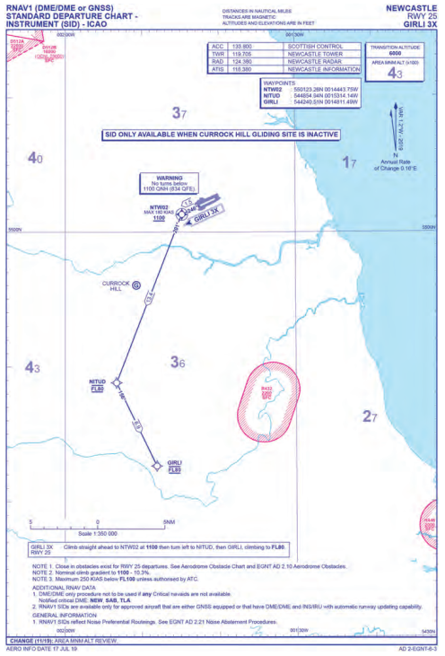
Runway 25
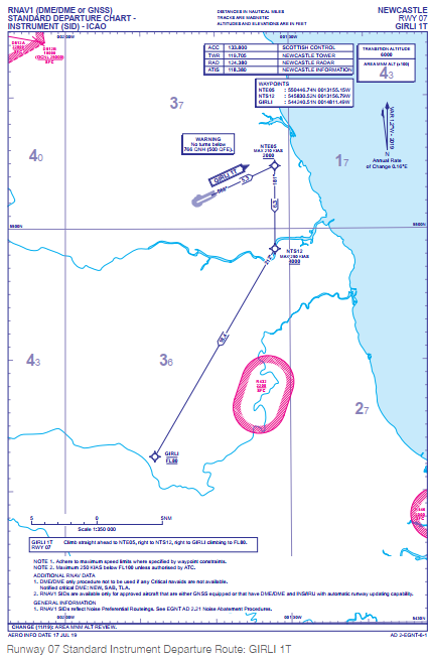
Runway 7
In both cases the vast majority of departing flights turn south about 2 miles or so after leaving the runway to head for the route to their final destination. There are some exceptions, but the turn south is the default. In both cases, the flight paths overfly residential areas at low altitude.
Aircraft always take off into the wind to take advantage of the additional lift. 70% of the year, the dominant wind direction is westerly – from the west. In these conditions, aircraft start their take off at the eastern end of the runway and accelerate westwards before becoming airborne. When the wind is from the east the other 30% of the time, the reverse is true.
Aircraft always land into the wind. There are two approved arrival flightpaths – east and west. When the wind is westerly, aircraft line up with the runway out over the North Sea. When it’s easterly, aircraft line up with the runway down the Tyne Valley.
The arrival flightpaths are not the reverse of the departure flightpaths
The runway extension
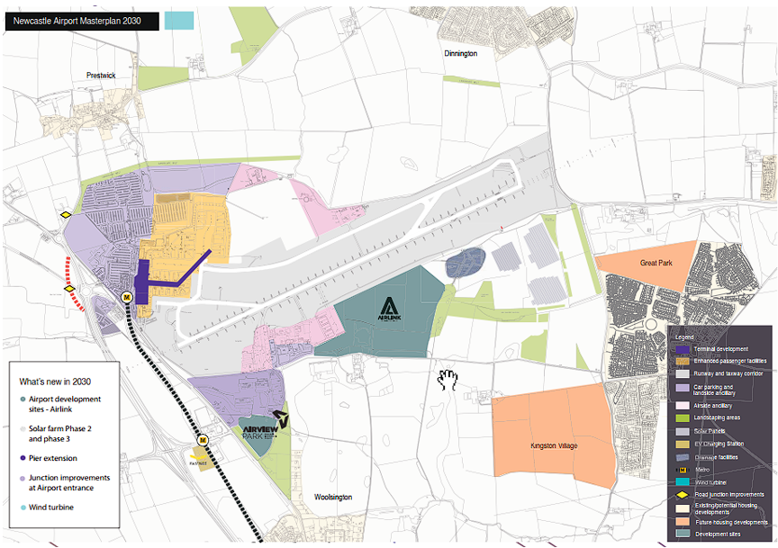 The runway as it is now
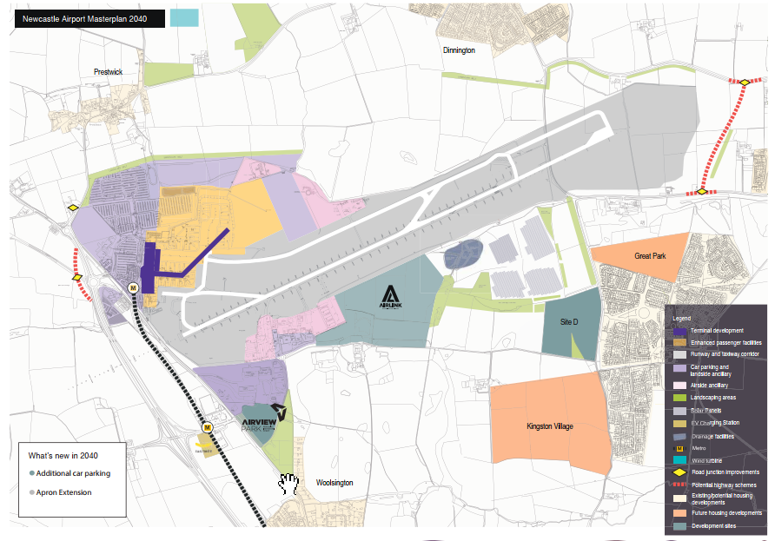
The runway extension to the east of the Airport
If the Airport's Masterplan 2040 is implemented as is, this is what the changes to the runways will look like. The main disruption from construction will affect people living to the east of the Airport.
The extension will mean that larger and heavier aircraft than at present will be able to fly to and from the Airport to more distant destinations.